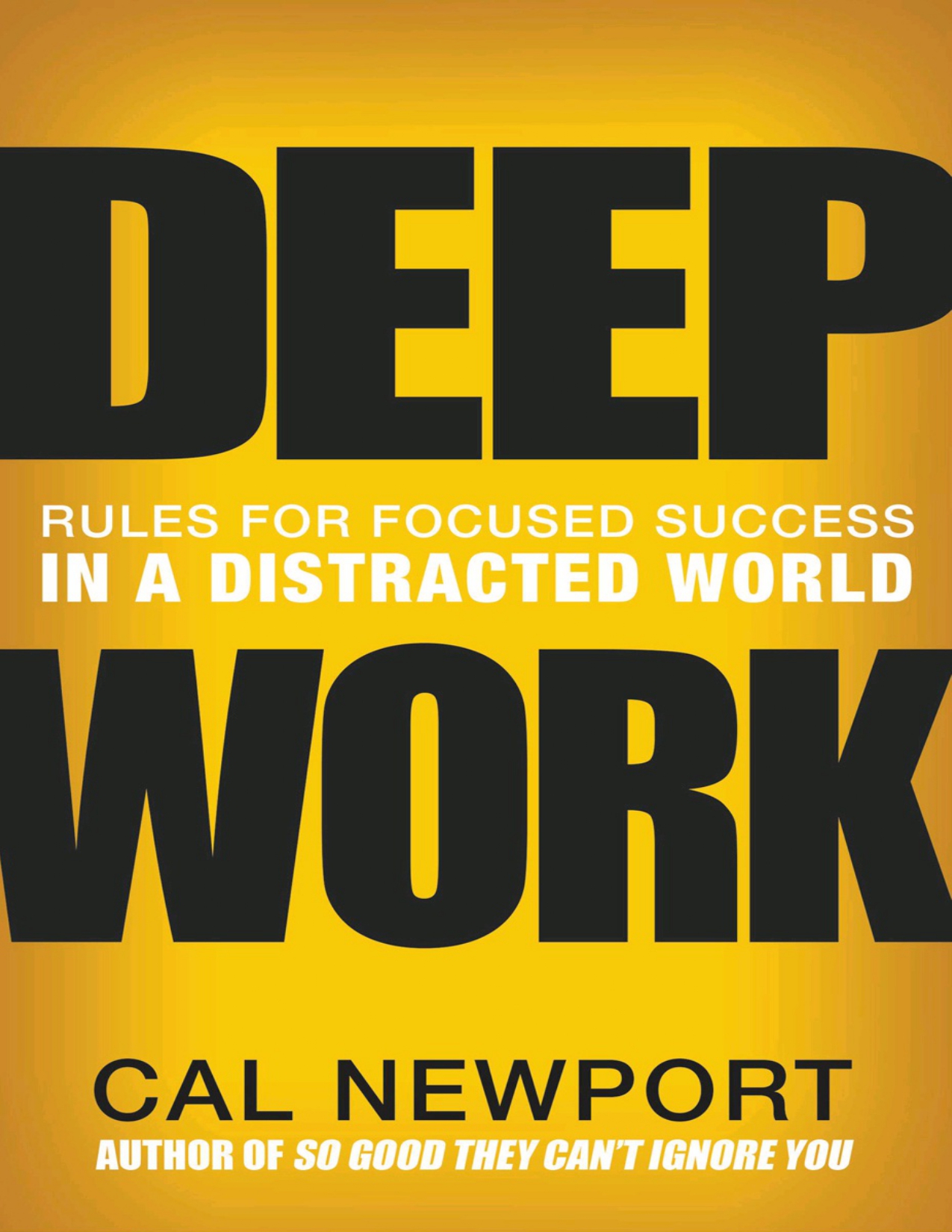
Deep Work
July 9, 2026
Everyone I talk to right now, clients, other founders, developers, is chasing the same thing. The next AI tool. The next model. The next automation that promises to do more with less effort. I build that stuff for a living, so I understand the pull.
But something has been nagging at me for months, and reading Cal Newport's Deep Work finally gave it words. The most valuable skill in 2026 isn't AI. It's the ability to sit with one hard problem for an hour without flinching.
The Ace: focus is becoming rare, and rare is what makes it valuable
Newport's argument is simple. We live in a world engineered to fracture attention. Every notification, every extra tab, every "let me just check this real quick" pulls you a little further from the work that actually matters. Research on attention in 2026 backs this up in a way that would have sounded exaggerated a decade ago: knowledge workers get interrupted every few minutes on average, and it takes close to half an hour to fully recover focus after each one. AI tools have added a new layer to that noise instead of removing it, another surface asking for a quick decision, a result to check, a prompt to refine.
The skill of ignoring all of that and staying with one hard task is becoming rarer at exactly the moment it's becoming more valuable. That's not a motivational quote. That's just supply and demand applied to attention.
Focus is a skill, not a personality trait
The part of the book that hit me hardest is that deep focus isn't something you either have or don't. It's a muscle. You build it the same way you'd build any other capability, by protecting time for it, by getting comfortable with a bit of boredom instead of reaching for your phone the second a task gets uncomfortable, and by giving one thing your full presence before moving to the next.
Most of us have let that muscle go soft without noticing. We fill every open minute with a scroll or a check-in, and then we wonder why a full day of being busy left us with almost nothing to show for it.
Shallow work keeps you busy. Deep work moves you forward
This is the distinction that matters most. Shallow work is replying, checking, updating, attending. It feels productive because it's constant. Deep work is the thinking that actually produces something new: a solution nobody had written down yet, a piece of writing worth reading twice, a system that didn't exist yesn't yesterday.
I see this play out constantly in the automation work I do. The whole point of a good workflow is to strip shallow work out of a business, the manual data entry, the repetitive replies, the reconciliation nobody enjoys, so that the humans running the business get their attention back for the decisions that actually require it. If an automation just moves the busywork around instead of eliminating it, it hasn't done its job. The same test applies to your own day. If a tool is adding more shallow checking to your routine instead of freeing up time for deep thinking, it's working against you, not for you.
What this looks like in practice
You don't need a retreat or a perfectly optimized morning routine to start. You need one deliberate hour.
- Pick one hard thing, the task you've been avoiding because it takes real thought, not the one that just takes time.
- Close every other tab and put your phone somewhere you can't see it, not just on silent.
- Give it sixty uninterrupted minutes. Not "mostly uninterrupted." Actually uninterrupted.
- Notice how uncomfortable the first fifteen minutes feel. That discomfort is the muscle waking up, not a sign you're doing it wrong.
If your mind feels scattered, you're not broken
You're just out of practice. That's true whether you're running a growing SME trying to keep up with orders, sitting in interviews trying to separate real signal from buzzwords, or building the next AI tool everyone will be distracted by next quarter.
Pick one hard thing today. Close every other tab. Give it sixty minutes with nothing else competing for your attention. That's where the real progress lives, and no tool, AI or otherwise, can do that part for you.