Speaking
Talks & Training
Conferences, workshops, and training sessions on AI, automation, and software development.
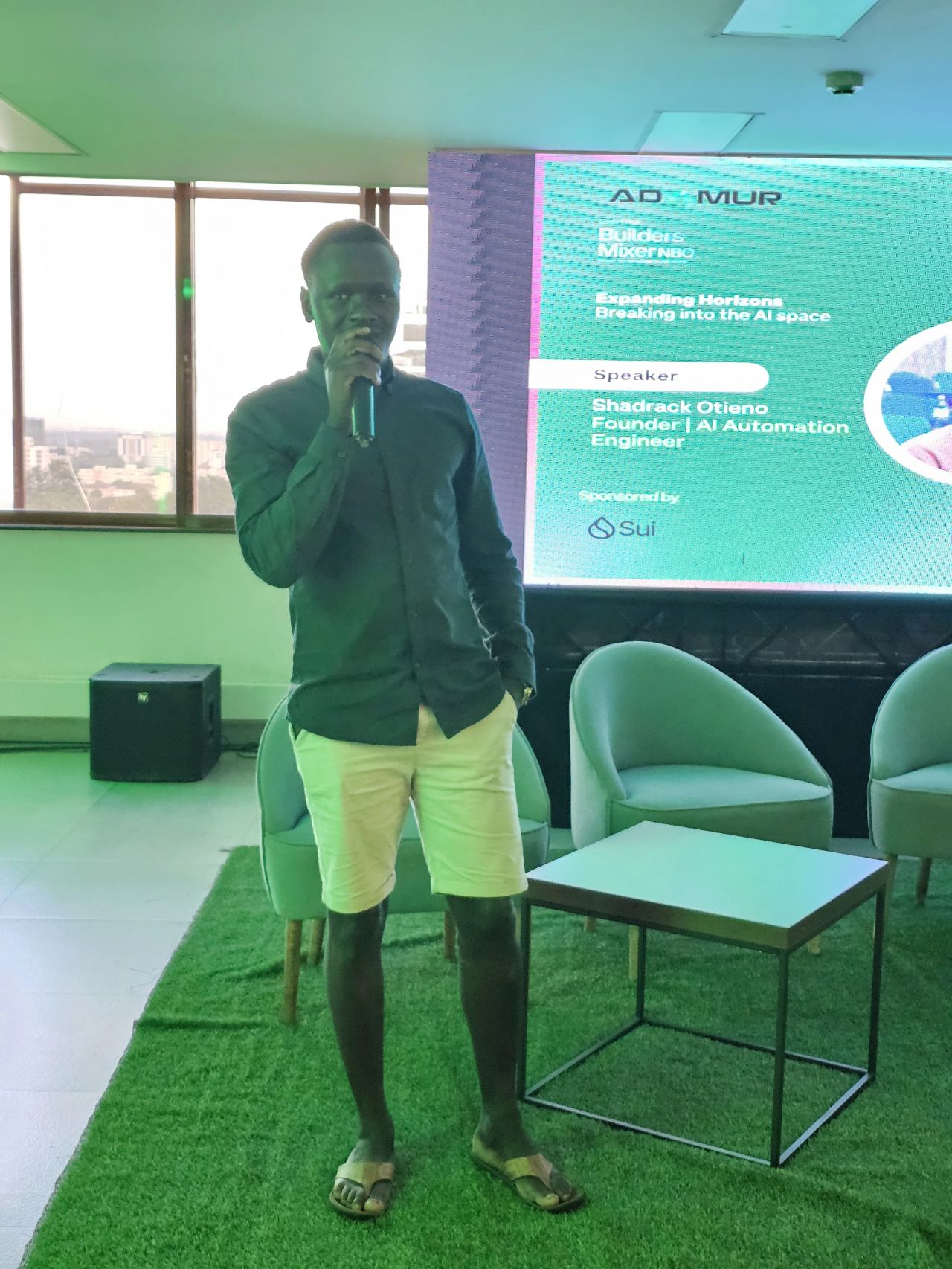
Automation Engineer
AI x Web3
Last Saturday, I had the privilege of attending the Builders Mixer NBO organized by ADAMUR, bringing together founders, AI engineers, and Web3 builders shaping tomorrow’s solutions. One key takeaway: Startups don’t die - they’re killed. Like babies, they come with no manual, and while mistakes are costly, the early days are when we should dare to make them. The intersection of AI and Web3 is becoming undeniable. These technologies won't evolve in isolation, they’ll merge to redefine how we interact with systems, data, and trust.
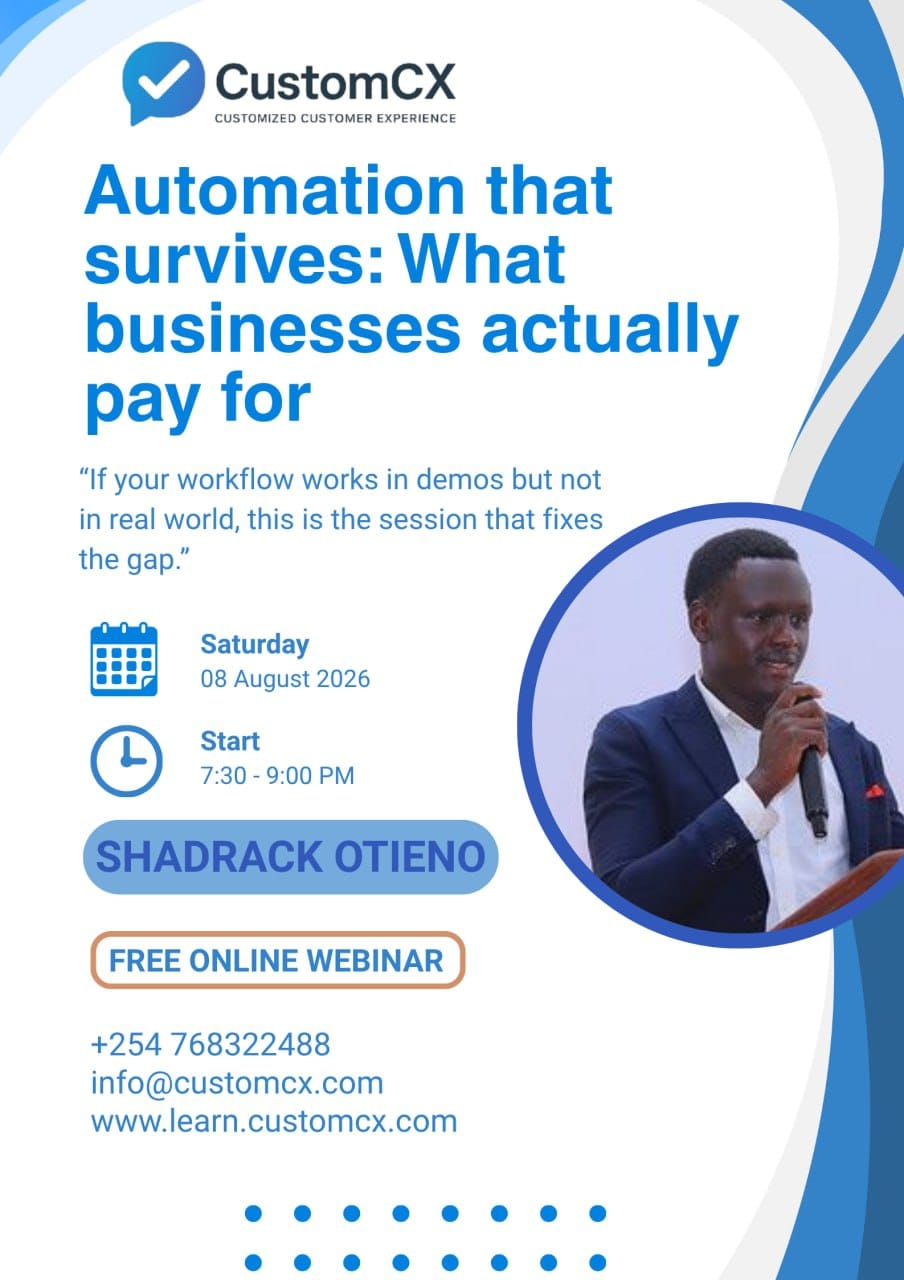
Automation that Survives: What businesses actually pay for
If your workflows work in demos but not in the real world, this is the session that fixes the gap.
Nobody teaches the part that actually matters. There is no shortage of n8n tutorials. There is a serious shortage of judgment. A few things I have learned the hard way building automations for real businesses: → Automating a broken process just breaks it faster. → Never automate something you have not done manually yourself at least three times. → The person who signs the cheque is not the person who uses it. And the user can kill your project silently. → Silent failure is worse than manual work. If you cannot answer "how will we know when this breaks", you are not done. → Demos run on the happy path. Production runs on edge cases. → If it dies when you leave, you built a liability, not an asset. Businesses do not buy workflows. They buy the removal of a cost, a risk, or a delay. That is what we are unpacking in the next CustomCX session. No screen shares. No node walkthroughs. Just the 20% nobody shows you. I am not promising this wins you clients. No framework does that. What it does is cut out the approaches that reliably fail, so your effort lands somewhere useful. https://calendar.app.google/PRST3xHQ9gPSjd788
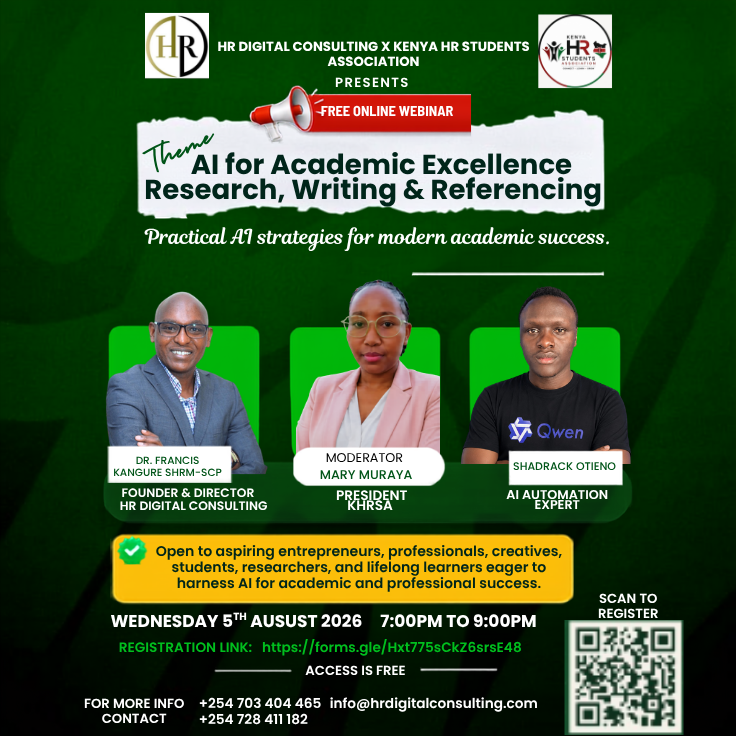
AI for Academic Excellence Research, Writing & Referencing
Practical AI Strategies for modern Academic Success
A free two-hour online session on how to use AI properly for academic research. We walk through the full research journey, from picking a question to defending your work, and show where AI genuinely helps and where it will get you in trouble. Includes a 40-minute live walkthrough of setting up an AI research workspace from scratch. For HR, business and university students, open to anyone. The fuller version, if someone asks what actually happens Most students using AI for coursework are doing it badly, and the ones doing it badly are the ones getting caught. They ask for a summary, accept it, and paste in citations they never opened. Some of those citations do not exist. This session teaches the other way of working. We break research into its real stages, question, literature, method, analysis, writing, defence, and go through what AI can honestly do at each one and what it cannot. Then Shadrack builds a working research setup live, in front of everyone, from an empty account: organising your sources, getting output in your department's format, asking in a way that forces real references, and checking every citation before it ever reaches your supervisor. Dr. Francis Kangure joins as a practitioner to give the view from the other side of the desk, what supervisors and employers actually notice. Mary Muraya moderates and runs the questions. The point is not to help anyone write faster. It is to help them produce work they can defend when someone asks where a claim came from. Wednesday 5 August, 7:00 to 9:00pm, on Google Meet. This is the launch session of the KHRSA and HRDC AI Skills Program.
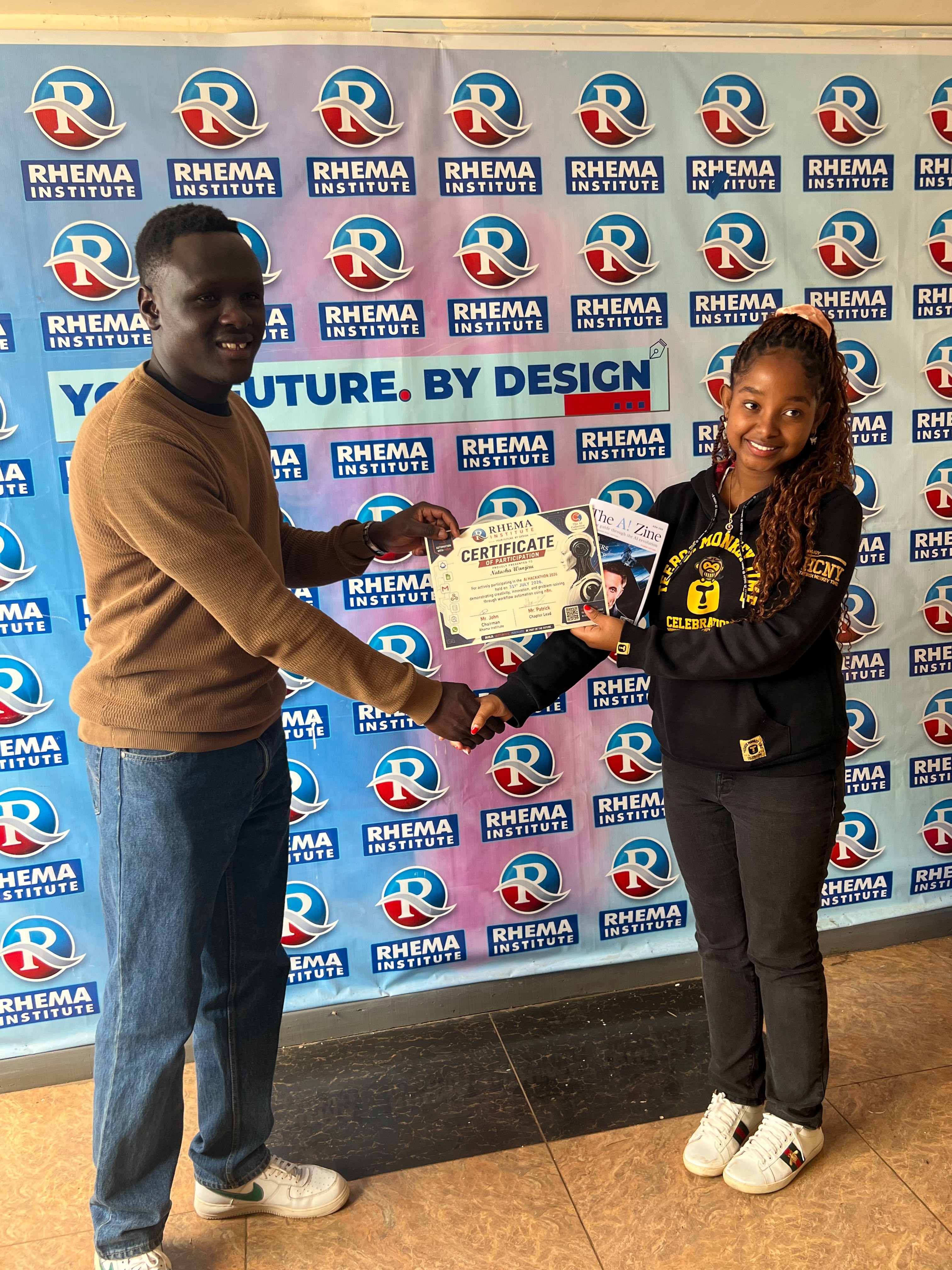
Judge, Rhema Institute x The AI Collective AI Automation Hackathon Nairobi, 2026
AI Automation hackathon
Invited by Rhema Institute to design the judging framework and evaluate over 50 submissions for an AI automation hackathon run in partnership with The AI Collective Kenya. The brief given to participants: identify a business process that is repetitive, error prone, time consuming or costly, map and document it end to end, then automate it with n8n, with three weeks to build. As judge, I set evaluation criteria that went beyond technical execution. Submissions were assessed on: Real-world grounding – the process had to solve an actual, observed business problem, not a speculative one Business impact – solutions needed to show measurable or credible financial impact, not just a working workflow Practical viability – whether the automation could realistically be adopted by the business it was built for This role drew on my experience organizing and planning technical programs, my hands-on automation background with n8n, and my broader commitment to mentoring and serving Kenya's growing AI and automation community.
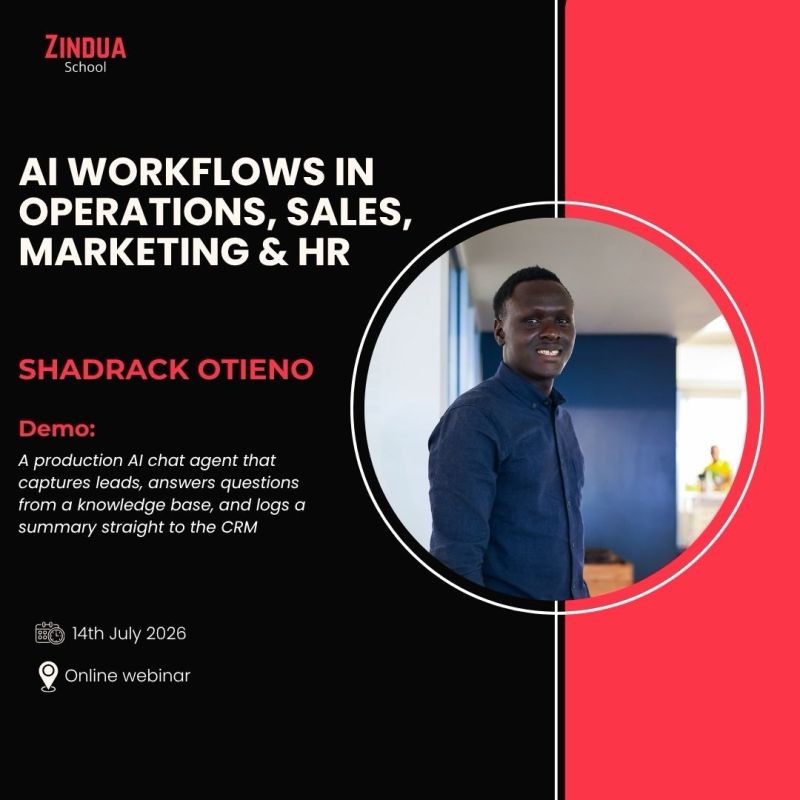
AI Workflows in Operations, Sales, Marketing & HR
AI Automation Master class
Excited to have Shadrack Otieno speaking at our upcoming webinar: AI Workflows in Operations, Sales, Marketing & HR 🎤 Shadrack is an AI Automation Engineer and Founder of CustomCX, with 3 years of experience building workflow automation. He's also a Qwen Ambassador and the Kenya Chapter Lead for AI Collective — holding a BSc in Computer Science. He'll be demoing a live, production AI chat agent — not a prototype, an actual system currently in use: 🔗 customcx.com/portfolio Here's how it works: 🔹 Before a client starts chatting, they provide their name and email — captured straight into the CRM 🔹 The conversation itself is powered by a business knowledge-base RAG pipeline, so answers are grounded in real, specific information 🔹 After the chat ends, the agent automatically sends a summary back to the CRM, attached to the contact record, along with a follow-up message This is what a fully closed-loop AI system looks like — lead capture, live conversation, and CRM follow-up, all handled automatically. Join us: 📅 Monday, 13th July 2026 🕗 8:00 PM · Online webinar Register: https://luma.com/exc1un0k
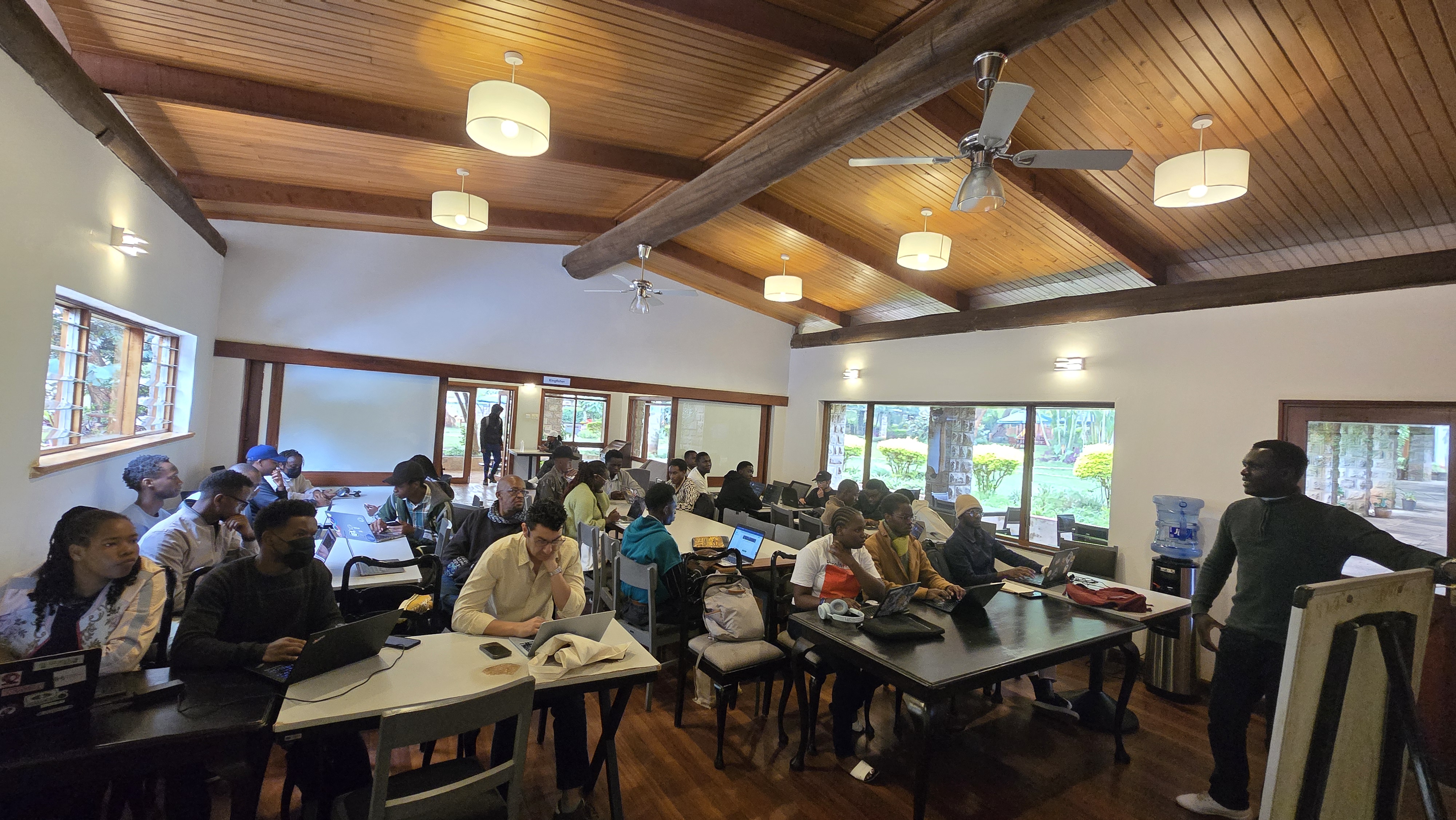
Build with qwen
AI Collective x Qwen
Workshop to explored the capabilities of Qwen 3.7 plus and 3.8 Max
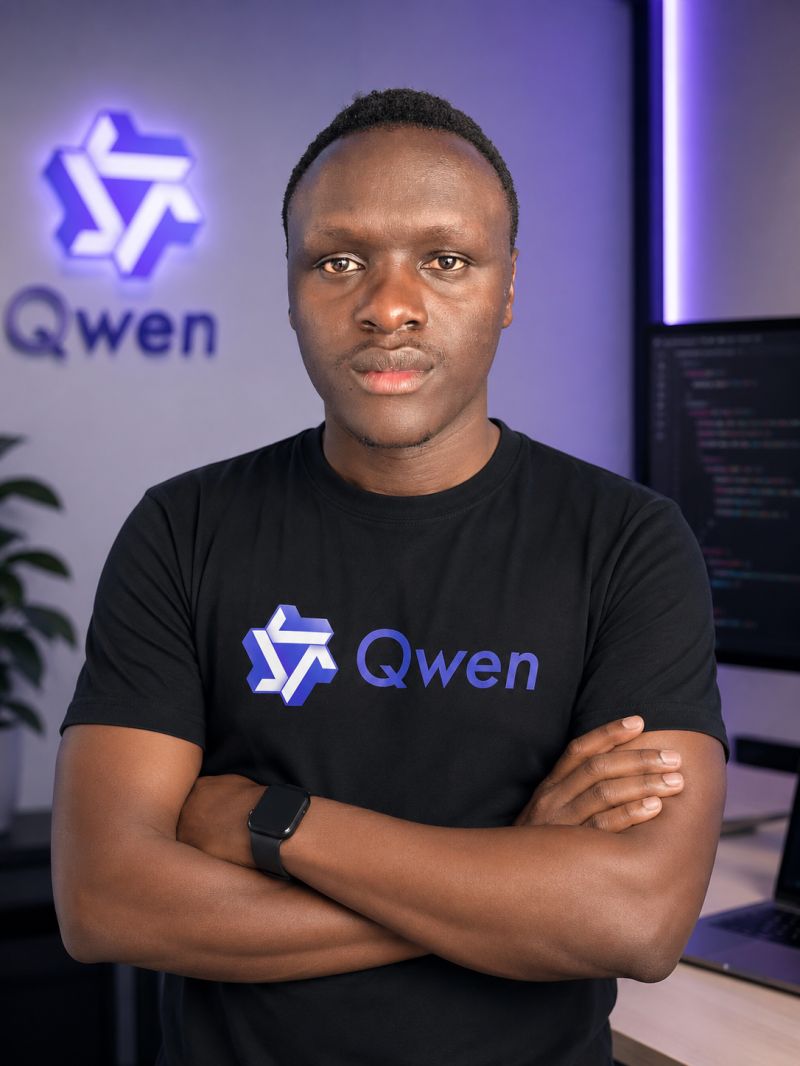
Build With Qwen
Build with Qwen (w/ The AI Collective)
I'm looking forward to co-hosting Build with Qwen together with The AI Collective Nairobi chapter, a hands-on workshop where we'll explore how to build AI-powered applications and workflows using Qwen's latest models and APIs (Qwen 3.7 max and qwen 3.7 plus). Whether you're a developer, student, founder, or AI enthusiast, this is a great opportunity to learn, build, and connect with the local AI community on 4th July 2026. 📅 RSVP here: https://lnkd.in/dFrdRwxB
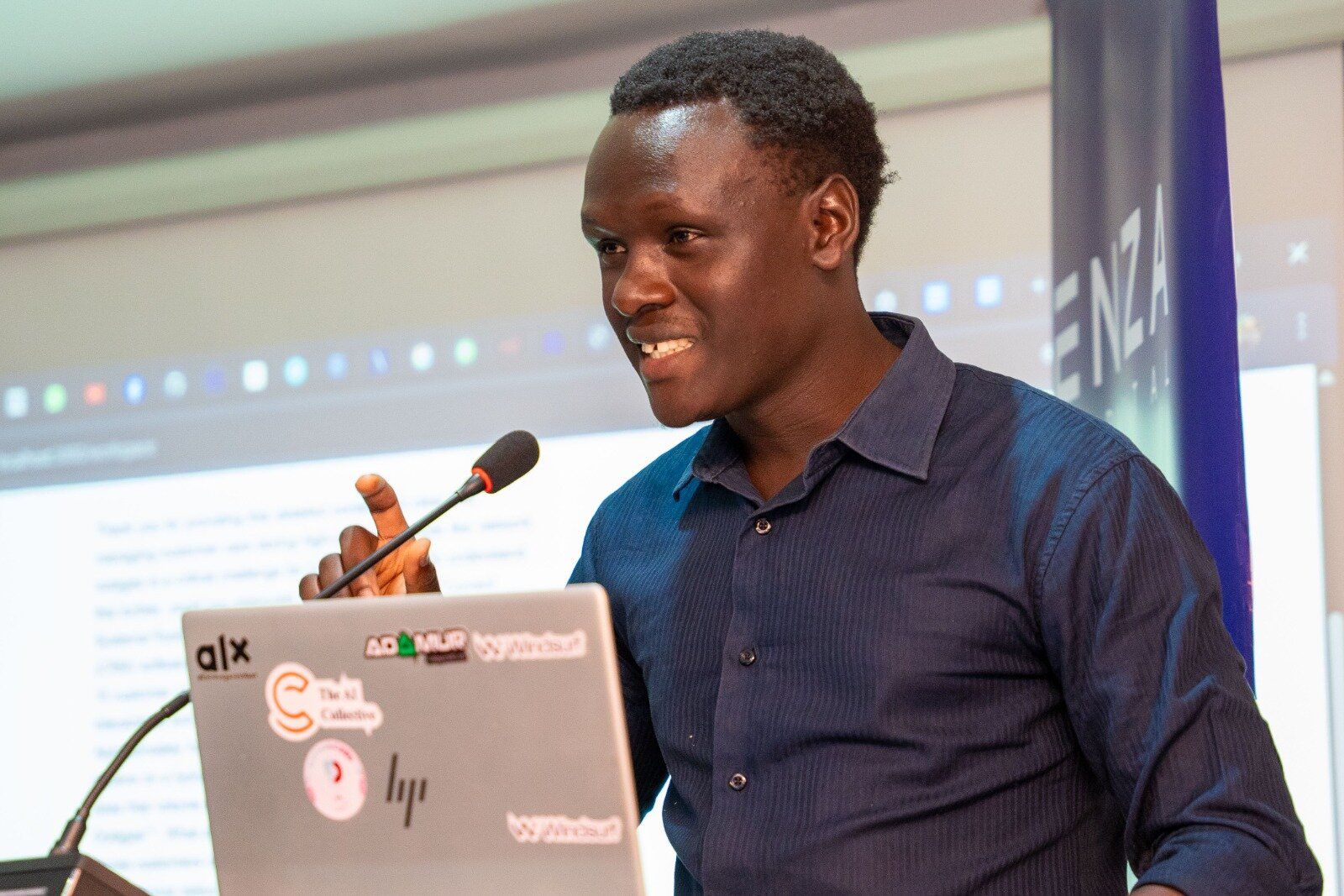
Presenter
AI Tinkerers 4th Edition
Honored to be invited back to AI Tinkerers 4th Edition to present our AI Business Audit Tool! 🚀 Check it out here https://lnkd.in/d-qdWXzS (alpha stage) Being asked to speak for the second time was incredibly validating. This time, I showcased an interactive solution that's transforming how businesses evaluate AI adoption. Here's how it works: Our tool conducts conversational audits through a chat interface, gathering critical data about: Current business pain points Existing technology stack Daily operational costs Time spent on manual tasks Once the business owner clicks "implement this proposed solution," our analysis agent takes over, calculating ROI, generating tailored recommendations, and creating concrete implementation roadmaps. The interactive approach makes AI adoption accessible and data-driven, helping businesses make informed decisions about automation investments.

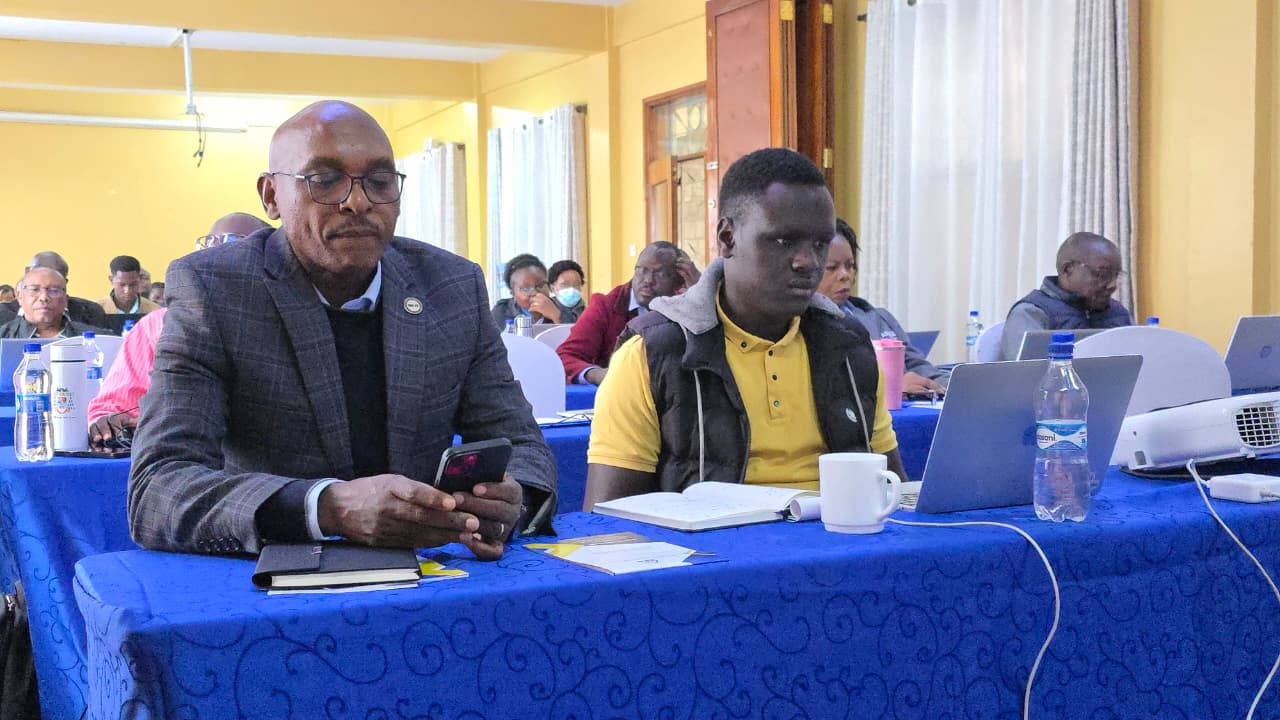
KASNEB AI WORKSHOP
Training on Prompt and Context Engineering
ToT Training on Prompt AND Context Engineering Prompt Eval
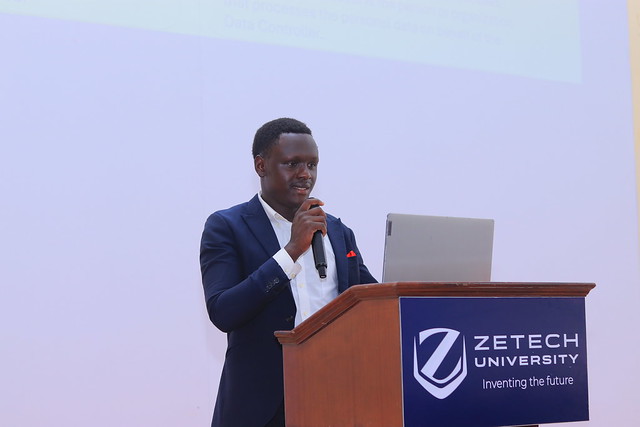
Integrating Generative AI Into Higher Education
Faculty & Leadership Training
The Integrating Generative AI into Higher Education faculty training at Zetech University brought together university leadership, professors, and lecturers to explore the practical, ethical, and pedagogical implications of Generative AI in teaching, research, and academic administration. The workshop focused on equipping faculty with the knowledge and frameworks needed to adopt AI responsibly while maintaining academic integrity and educational quality. As one of the lead facilitators, I delivered sessions on **AI Ethics, Policy, and Privacy in Academic Work**, guiding faculty through responsible AI adoption, data privacy considerations, hallucination verification workflows, and the emerging need for institutional AI policies. I also demonstrated practical strategies for evaluating AI-generated content beyond AI detectors, emphasizing verification, transparency, and assessment redesign as essential components of responsible AI integration. The training contributed to strengthening AI literacy among faculty while fostering meaningful discussions on the future of higher education. Through hands-on demonstrations, evidence-based discussions, and practical recommendations, the session helped lay the foundation for a more structured and strategic approach to AI adoption, supporting the university's broader digital transformation journey and preparing educators for an increasingly AI-enabled academic environment.
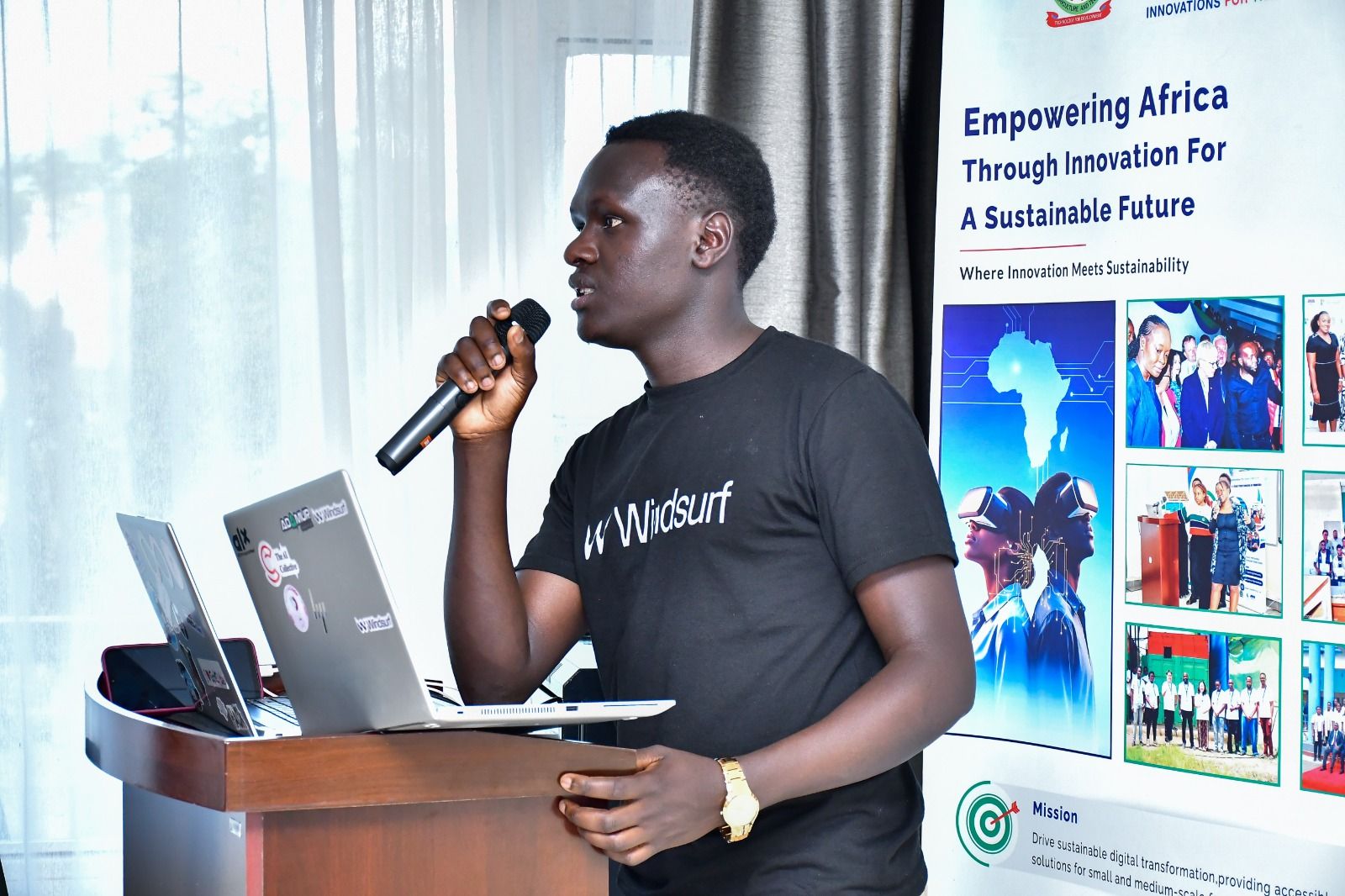
Tech Advocte
Windsurf Open Build
successfully hosted the Windsurf Open Build Nairobi at Jomo Kenyatta University of Agriculture and Technology (JKUAT)), bringing together over 80+ developers, builders, and AI enthusiasts under one roof. Highlights from the day: ✨ Hands-on experience with Cascade, Windsurf's powerful AI agent, as developers explored its capabilities in real-time 💡 Diverse projects showcased across agritech, edtech, and innovative solutions that demonstrated the versatility of AI-assisted development
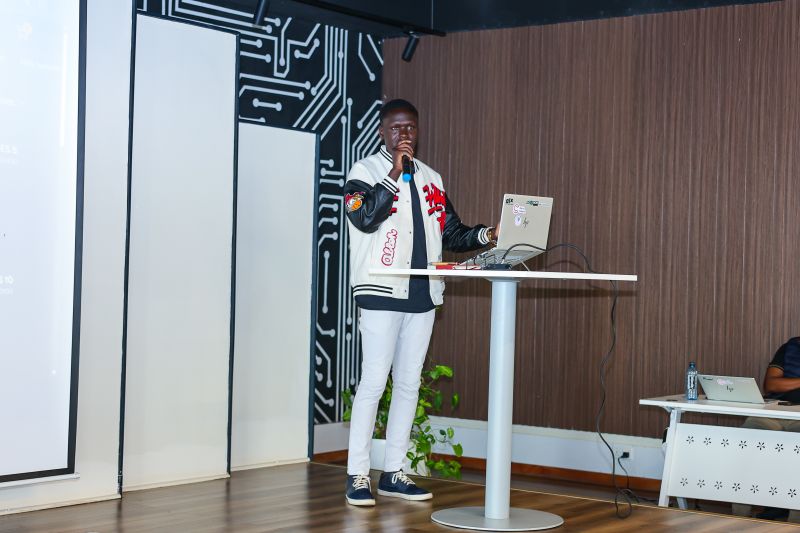
Windsurf Open Build Nairobi. Powered by Windsurf & The AI Collective
Windsurf Open Build Nairobi
💡 Key Highlights: We explored Windsurf’s Cascade, Code, and Write Modes, and learned how to deploy directly to Netlify. Developers tested switching between different LLMs (GPT-5, Sonnet-4, etc.), experiencing first-hand how model choice impacts results. Practical lessons included secure development with test APIs, ensuring safe handling of credentials while building payment features. Attendees practiced AI collaboration techniques, using self-criticism prompts like “Review this response and tell me what’s wrong, then fix it.” and step-by-step guidance like “Break down the project into stages and work through them one by one.” These simple but powerful methods showed how AI can become a true coding partner, not just a code generator...